
How to Rig a Slackline Without Trees
When someone says slackline, most of us picture a line stretched between two trees somewhere in a park. But what if there are no trees around? That’s what we’ll look at in this article.
You’ve got yourself a slackline and you go to the park every now and then, but you’d like to rig your line in your garden, where there happen to be no trees. There’s only one solution – anchor the line directly into the ground and prop it up on A-frames. It may seem complicated, but if you anchor the line properly, it’s no rocket science. And since a picture is worth a thousand words, here it is:
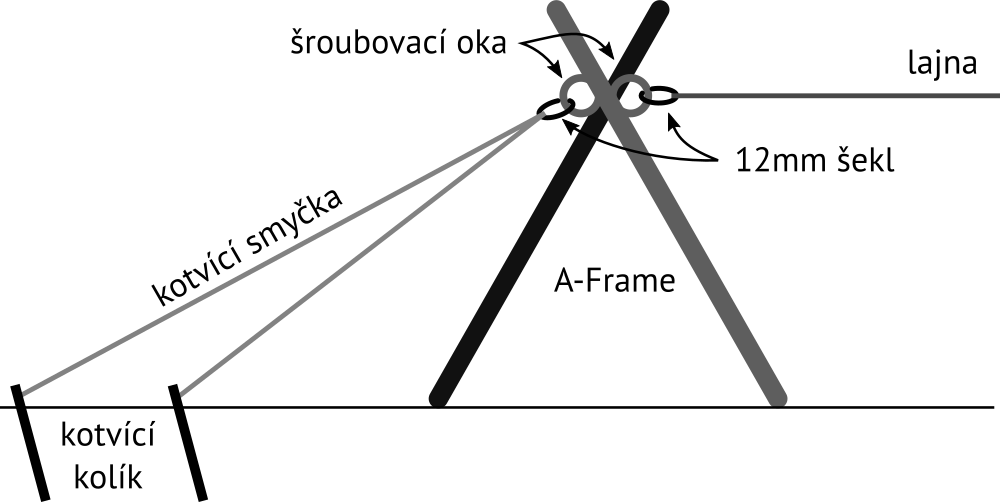
There are several ways to anchor into the ground. The easiest is to get ground anchors or stakes and simply screw or hammer them into the soil. However, this is the least reliable solution, and in stony ground, screwing in a stake can be quite a struggle.
If you’re thinking about keeping a slackline in your garden long-term, burying a T-shaped ground anchor, a so-called “deadman”, may be the right solution for you:
- Dig a T-shaped hole in the ground. Depending on the soil type and the length of the line, we recommend a depth of at least 75–120 cm.
- Place a sufficiently strong beam or steel pipe in the shorter part of the hole, attach a strong rope or chain perpendicular to it, and run it through the longer part of the hole to the spot where you’ll anchor the slackline itself.
- Then fill the whole hole with soil and compact it thoroughly.
Only a small piece of rope or chain will stick out of the ground, so you can still mow and look after your lawn.

Freestanding frame
A rather expensive, but quick and safe solution. It’s especially suitable for indoor use. We offer the 3m Slack Base frame. It’s particularly popular with leisure clubs, schools, kindergartens and event agencies.
Drilling into concrete
If you have a suitable concrete wall in your garden, you can anchor the line to it using expansion bolts or chemical anchors, ideally loaded in shear – meaning the line never pulls along the axis of the drilled bolt. It’s a good idea to place at least 2 bolts on each side of the line and connect them with an equalised anchor. That, however, is a fairly complex matter beyond the scope of this article.