
How to choose a tensioning system
How to tension a slackline: from ratchet to pulley system
An overview of tensioning systems and the line lengths they suit
There are several ways to tension a slackline. Each has its pros and cons, so let’s take a look at them one by one.
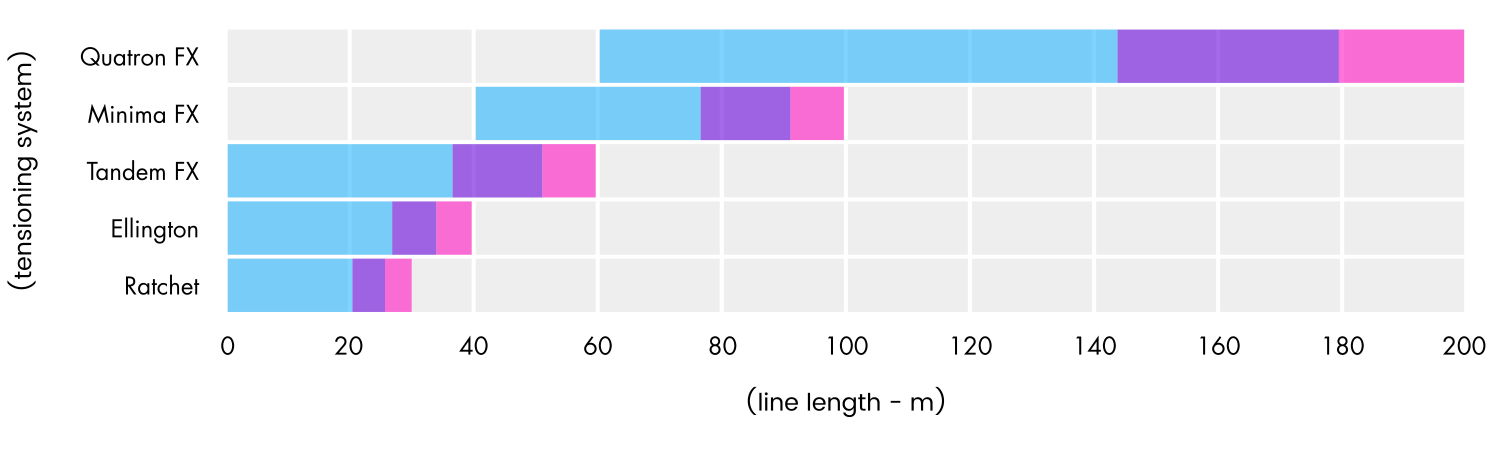
Ratchet up to 20 m
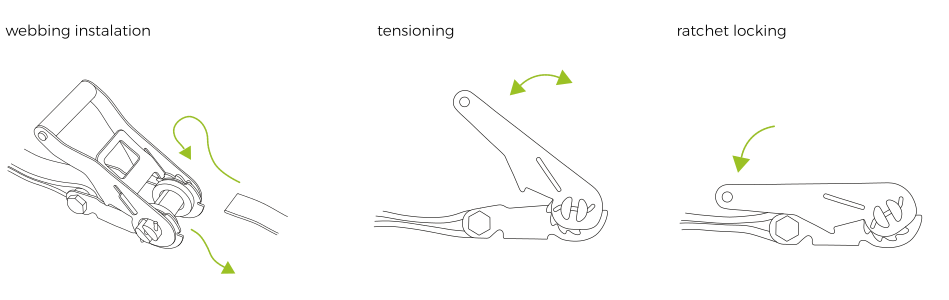
A ratchet is a simple mechanism for tensioning webbing. The tension it creates is based on a fixed lever ratio that cannot be changed. In other words, the more you want to tension the line, the more force you have to apply – and beyond a certain line length, not even strong muscles will help.
A ratchet is ideal for tensioning basic slackline kits up to 20 m long, or tricklines.
Pros
- Simple and quick operation
- Low price
Cons
- Tension in the system cannot be released easily
- Limited reel capacity
- Faster wear of moving parts
Ellington (“primitive system”) up to 30 m
Ellington, also known as the primitive system, is a simple pulley system with a 4:1 ratio. It uses steel carabiners instead of pulleys and webbing instead of a rope.
It’s suitable for lines up to 30 m long.

Pros
- Low weight
- Low price
- Extremely reliable when installed correctly
Cons
- Tension cannot be released easily
- Requires proper handling
Soft-release up to 30 m
A soft-release is essentially a single piece of webbing wound several times between two shackles or carabiners and secured with a knot. It is mainly used to release a line tensioned with a Linegrip, but it can also be used to tension the line itself. In principle, it’s a very simple webbing pulley system without a brake. EQB Sheriff FX is commonly used when tensioning with a soft-release.
It can be used to rig lines up to about 30 m long.

Pros
- Low weight
- Low price
Cons
- Low efficiency
- Requires some skill
Buckingham up to 50 m
Buckingham is a tensioning system that uses a Linegrip and a weblock (ideally EQB Sheriff FX) to build a pulley system, with the tensioned webbing itself used instead of a rope. Thanks to its low weight, it is popular for highlining. Its efficiency depends on the weblock geometry as well as the weave and stretch of the webbing.
It is typically used to tension lines up to 50 m long.
Pros
- Low weight
- Requires little gear
- The tensioning system doesn’t stay on the line
Cons
- High webbing-on-webbing friction in the weblock
EQB Tandem FX up to 100 m
Tandem is a professional webbing pulley system based on the soft-release principle. The main difference is that it has a built-in weblock for 25 mm webbing and a brake, which lets you achieve far more tension than with a regular soft-release.
With additional Rollex pulleys, Tandem can tension lines up to 100 m long – check out the longline kits Zen Pro and Zen De Luxe.

Pros
- Low weight
- Tension is easy to adjust
- High efficiency
Cons
- Requires some skill
Rope pulley system over 50 m
The most common way to tension lines over 50 m long. A rope pulley system consists of pulleys, a rope, a rope brake and connectors. Different pulley combinations increase the mechanical advantage, so you can tension a line of practically any length.
A 100 m longline can be tensioned with EQB Minima, and a 200 m line with EQB Quatron.

Pros
- High tensioning efficiency
- No limit on system length (important for high-stretch PAD webbing)
- Versatile
Cons
- Higher cost
- Requires knowledge of tensioning techniques
Slackline kits
Try slackline
All our kits are developed, tested and made by us in the Czech Republic.